Worlds of Hungarian Writing by András Kiséry
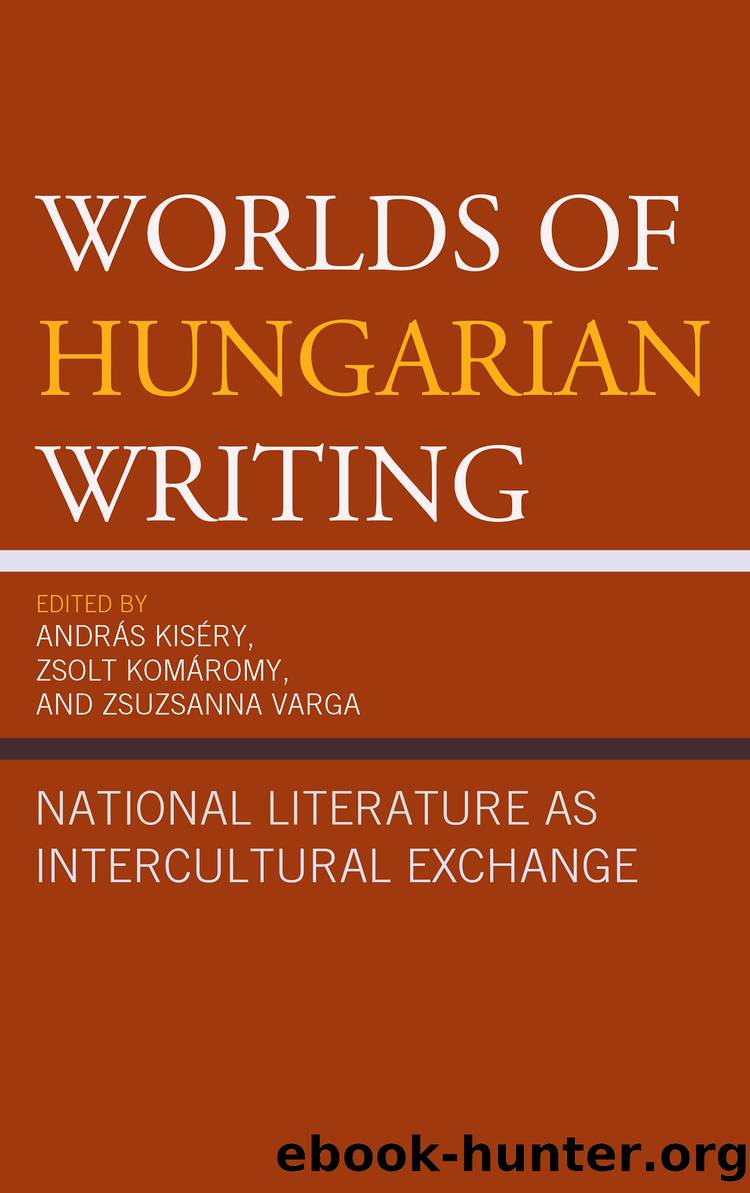
Author:András Kiséry [Varga, Andras Kisery;Zsolt Komaromy;Zsuzsanna]
Language: eng
Format: epub
Publisher: Fairleigh Dickinson University Press
Published: 2016-11-15T00:00:00+00:00
7
The New Leftâs Use and Abuse of György Lukácsâs Thought
György Túry
Few would deny that the work of the Hungarian philosopher György Lukács was central to the thinking of the New Left in the 1960s and 1970s. His 1923 masterwork History and Class Consciousness is one of the Ur-texts of the movement and of the era in general. One certainly hears less about his essay âThe Old Culture and the New Cultureâ from 1919. However, this essay played a very interesting and complicated role in the development of New Left thought in the 1960s and 1970s, as well as in its reception in mid-1970s socialist Hungary. In what follows, I will concentrate on the initial reception and perception of Lukács by the New Left, focusing on one of the movementâs leading West German thinkers, Hans Magnus Enzensberger. I will argue that Enzensbergerâs reading of Lukács informed the (semi-)official reception of Western New Left thinking in Cold War Hungary, and suggest that the (ab)use of Lukácsâs thought that characterizes this process of reception also contributedâif in a subtle way that is almost impossible to textually documentâto the initial theorizing of the function, nature, and practice of underground publishing (i.e., samizdat).1
Cold War Exchanges
In the early 1970s, during a relatively liberal era in Hungary, a book project was proposed by the publishing house most closely associated with the ruling Hungarian Socialist Workersâ Party.2 This anthology was designed to introduce contemporary West European and North American New Left thinking to the public. György Dalos, a writer, translator, and oppositional intellectual was contacted and asked to cover the German language material for the project. He happily accepted the offer and set to work on the selection and translation of texts.
In his work, Dalos relied on an earlier inspiration. In May 1970 he had met Hans Magnus Enzensberger, at an international conference of poets in Budapest. At that meeting, Enzensberger handed a copy of the most recent issue of his journal Kursbuch to the young Hungarian poet, and Dalos was so impressed that he became an avid reader of the periodical which, despite its theoretical-political orientation, was available in the library of the Hungarian Association of Writers. Upon considering the possible texts for the book project, he remembered an essay by the editor of the journal, Enzensberger himself. This essay, entitled âConstituents of a Theory of the Media,â was an example of radical, New Left media theory, and it was also critical of Lukács.3
Dalosâs story is an instance of the traffic of people, ideas, and texts between East and West in the Cold War era, and an example of the now widely recognized porousness of the Iron Curtain,4 which was not as hermetically sealed a dividing line as Cold War studies have traditionally led us to believe. The episode above also illustrates the surprising and coincidental nature of events in such exchanges. A young,5 unknown Hungarian poet, writer and anti-establishment intellectual, György Dalos, had the opportunity to meet Enzensberger, West German public intellectual par excellence,
Download
This site does not store any files on its server. We only index and link to content provided by other sites. Please contact the content providers to delete copyright contents if any and email us, we'll remove relevant links or contents immediately.
The Hating Game by Sally Thorne(19285)
The Universe of Us by Lang Leav(15087)
Sad Girls by Lang Leav(14437)
The Lover by Duras Marguerite(7911)
The Rosie Project by Graeme Simsion(6425)
Smoke & Mirrors by Michael Faudet(6200)
Big Little Lies by Liane Moriarty(5817)
The Poppy War by R. F. Kuang(5715)
The Shadow Of The Wind by Carlos Ruiz Zafón(5700)
An Echo of Things to Come by James Islington(4890)
Memories by Lang Leav(4808)
What Alice Forgot by Liane Moriarty(4646)
From Sand and Ash by Amy Harmon(4533)
The Poetry of Pablo Neruda by Pablo Neruda(4116)
The Tattooist of Auschwitz by Heather Morris(3854)
Ficciones by Jorge Luis Borges(3646)
The Rosie Effect by Graeme Simsion(3475)
Guild Hunters Novels 1-4 by Nalini Singh(3472)
THE ONE YOU CANNOT HAVE by Shenoy Preeti(3381)
